UPDATE: Reviews section refreshed, redesigned, searchable: Go take a look
Titanium alloys have an endurance limit - that is, a stress level below which fatigue failure will not occur. This is the same for ferrous alloys (steels). Aluminium alloys do not have this, so even if the stress level is within the elastic limit, failure will occur at some point.
I would guess/hope that the design of the frame is such that any stresses are easily within the endurance limit of the material so failure will not occur. I say easily, because there would be a great deal of uncertainty of the stress levels at any welds.
Effectively you have a cantilever beam with a load at one end (at the drop-out) and fixed at the other (at the BB). The highest bending moment occurs at the BB (beam length x load) and the stress at this point (ignoring stress raisers such as the welds) is given by (bending moment x deflection)/second moment of area. So knowing the section properties at the BB you can calculate a stress level - allow extra for stress raisers and Bob's your mothers brother.
so if:
l = 0.4m
f = 2000N (assumes 200kg to bottom out shock)
then m = 800Nm
assuming 2 stays and that shock supports half the load = 200Nm/chain stay
estimating second moment of area for an elipse (I have assumed solid for simplicity but it shouldn't be too far off):
major dia = 0.025m
minor dia = 0.015m
I = 1/4 x pi x minor x major^3
I = 1.84E-07
Deflection = 0.05m
Therefore the stress = 54MPa
Which is quite easily within the range of an endurance limit for a titanium alloy even if you consider a 5 times factor for stress raisers and the other simplifications.
Suprising how far you can get with simple calcs 🙂
oops - I assumed 2" of travel not 1", so even better
Aluminium alloys do not have this, so even if the stress level is within the elastic limit, failure will occur at some point.
Even if the stress level is within the elastic limit, fatigue failure can occur with ti and steel. That's inherently the case unless those materials never fatigue (fairly sure all metals do to some extent or another), since as soon as you go beyond the elastic limit we're into plastic failure, not fatigue. As Brant points out (he'd know better than me, or most on here), steel components are designed so that they stay within the elastic limit, not necessarily within the endurance limit.
Suprising how far you can get with simple calcs
Yes, but GIGO. Not convinced assuming a solid is a very good approximation for example given how thin the walls are typically on a bicycle frame tube.
Ti and Steel DO have a stress level below which failure will not occur - termed the endurance limit. This will be within the accepted elastic range but depends on the specific material. Failure at loads above the elastic limit (i.e. plastic) are still fatigue - just at lower life at which point LCF strain-life becomes dominant along with many other considerations.
I would be concerned if components are not designed with the endurance limit in mind. The elastic limit describes the point at which the onset of yield becomes significant (typically at 0.2% strain) which could lead to low cycle fatigue - materials are NEVER completely elastic UNLESS they have an endurance limit and are below that limit. I do hope that someone with at least a bit of structural analysis capability designed my kit!
And tbh I couldn't remember or be bothered to find the formula for second moment of area for a hollow ellipse!
And tbh I couldn't remember or be bothered to find the formula for second moment of area for a hollow ellipse!
You already used it... just subtract the "internal" ellipse from the external one...
Materials scientist here. Although not going to claim to be a failure analysis or fracture mechanics expert.
I'm going to avoid getting drawn on some specifics of materials properties being thrown around in this thread. I would agree with the others who posted regarding the endurance limit (i.e. below a certain stress the fatigue life is practically infinite) of certain titanium and ferrous alloys, this was also my understanding.
Short answer to the OP - I wouldn't worry. This isn't based on any sort of professional judgement - it's just that plenty of other people have done it: Ibis, Moots to name a couple.
When I first saw this thread it reminded me of an Ibis I read about years ago - turns out it was the Ibis Bow Ti - which it also turns out was developed by the same guys Brant mentioned earlier in the thread:
[img] 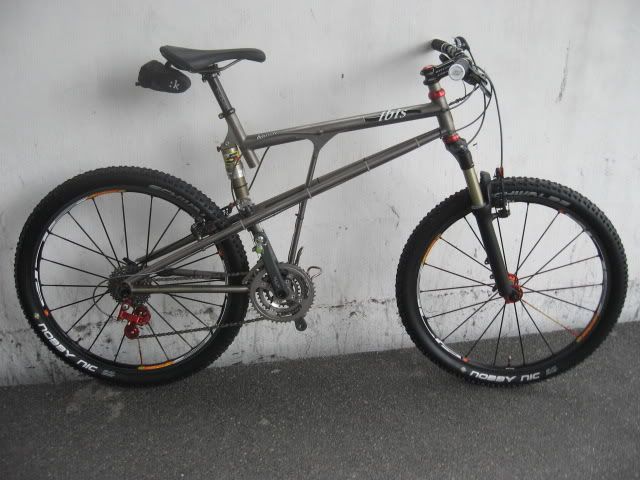 [/img]
http://www.castellanodesigns.com/diff.html
Moots are still making the YBB by the looks of things
http://www.moots.com/#/product/bicycles/mtb_26/ybb/
I've not come across pivot-less softails made out of any other materials other than Ti (EDIT: with the exception of the Fango already referenced). Maybe that's a fatigue related thing, maybe it's easier to get an appropriate spring-rate vs stiffness balance - dun know? Lahar did a pretty random carbon fibre thing though (though that's more of a soft(hard)tail I suppose):
[img] 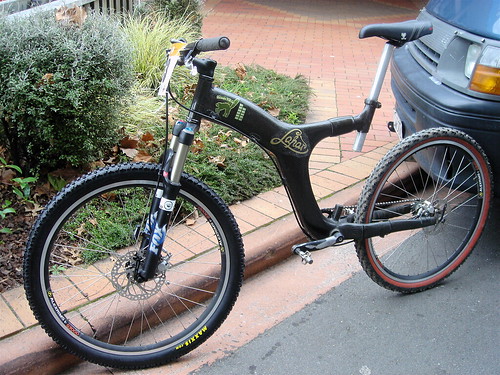 [/img]
I would assume these designs aren't that popular because people think (rightly or wrongly) they are going to break. That was my first thought when I saw that Ibis years ago. No plans on owning one, but I personally think they are a pretty interesting design.
the man is jealous!
[suck teeth mode]It's the poor quality welding that'll do for it, son.[/suck teeth mode]
Brant - both point valid but
1. the natty aluminium chainstay bridge is only necessary if the simple oval/circular section tubes don't work with alu, no? I hypothesise anyway, maybe he just wanted an expensive gimmick to make people believe it would work anyway.
2. I wouldn't expect any frames to be designed for infinite fatigue life, maybe only a judgement of useage and cycles. As you know there are empirical (crap) rules for adding your high/low cycle fatigue and given the fluffiness of any estimates of useage, riding and major impacts I'd be surprised if many even did that.
Anyway, I'm not a bike designer so toodle pip 😆
>I've not come across pivot-less softails made out of any other materials other than Ti
Cannondale Scalpel ?

